Vicissitudes and Daily Life of an Outskirts Writer
"For someone who is beyond me: God, The Almighty"
By Gilberto García Mercado
When living in an outskirts neighborhood, the writer faces several universes. I say several universes because, in that confined space, the virtues and vices of the human race converge without anyone getting hurt—provided one is a resident of the area. I know of no case where a virtuous person has had trouble with a wicked one simply due to inhabiting the same neighborhood. Those events that break from the norm perhaps happen because they are already marked by Providence, situated toward the negative pole of these unnamed outskirts. These events might be the exception to what I previously stated: that in a neighborhood like ours, good and evil look each other in the eye; they don't say hello, yet it's as if they constantly do. They respect one another and, despite some stumbling blocks, they pick themselves up and both continue that daily path, crucified by the public opinion of scorn and ignominy simply for living in the outskirts.
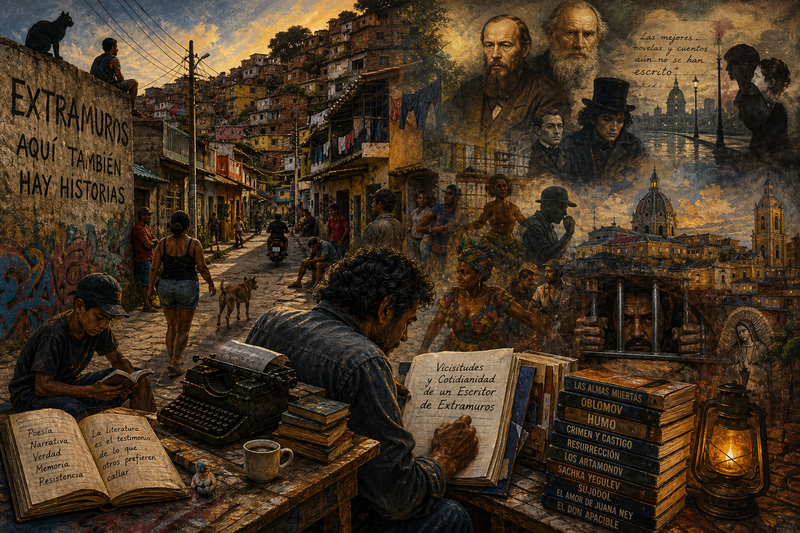
In these urban frontiers, Literature remains the same whether we are French, Chinese, German, English, or Hispanic American. What makes it different is the support it might receive from the State, decentralized agencies, private enterprise, universities, and schools. This support allows people to say, now as in the past, for example, that the best literature is still Russian. Consequently, its ten greatest novels of all time are: Nikolai Gogol's Dead Souls, Ivan Goncharov's Oblomov, Ivan Turgenev's Smoke, Fyodor Dostoevsky's Crime and Punishment, Leo Tolstoy's Resurrection, Maxim Gorky's The Artamonov Business, Leonid Andreyev's Sashka Yegulev, Ivan Bunin's Sukhodol, Ilya Ehrenburg's The Love of Jeanne Ney, and Mikhail Sholokhov's And Quiet Flows the Don.
In an outskirts neighborhood, the finest Literature is found; the problem is that not even a single genius has arrived to make it transcend. Nor has the necessary aid arrived to stimulate so many novice writers whose talent remains ignored, and who, due to so many vicissitudes, slip and fall along the way, faint, and never rise again. They decline and end up throwing in the towel in their final round against the adversities opposing narrative, short stories, or poetry. "The best novels and stories have yet to be written," I often hear, and I use that expression to reflect, for I am in the right neighborhood, embracing the great Literature that flows in these outskirts.
However, it is worth reiterating that in an exclusionary zone, the writer is marginalized. Public services are not the best, minors are already smoking cannabis sativa, overcrowding in homes is a singular reality, and a neighbor might turn on a sound system—a pick-up—shattering decibel limits on Saturday morning and not turn it off until Monday night. Here, bandits take refuge, as does the charlatan who boards buses claiming to be blind, only to spend the proceeds of living off people's mercy on beer around the corner, returning with the same scruples to the same grind the next day.
For the writer—call them a survivor of the Holocaust that literature encapsulates—these situations represent their best school, their best university. Here one encounters all the passions, the problems of the spirit, and man's gifts for good or ill. Literature, depending on the talent of the one writing it, will always emerge unscathed. There are so many stories to unravel, so many strange and dissimilar behaviors, that narrative and poetics will always find cause to celebrate in these outskirts neighborhoods...
To establish a writer's position regarding the atmospheres and environments of these marginalized zones, suffice it to say that the narrator will always have something to tell, a hypothesis to propose, a behavior to applaud or condemn, a universal vision contemplated from the thresholds of poverty, violence, and drug addiction. It is, then, a perspective that provides many personal lessons through the daily life of a community that seems to speak different languages but is united and understood by an internal forum—something significant that allows fire and water to coexist on the same stage. Someone once asked me, "How can you write in an outskirts neighborhood?" But embedded as I am in the barrio, I find more difficulty writing outside my environment than I do within it.
There is so much material in every aspect that the writer becomes a watchman, a confidant of souls, a healer with words, an observer of the lazy woman who prefers to sell her body than to work. Here, too, is the mistress who wakes up at eleven in the morning, and the domestic worker is her mother, to whom she pays for her favors.
In these marginalized areas, one can feel the breath of characters like those in In Cold Blood—the Non-Fiction Literature—that American writer Truman Capote used to write and recreate, perhaps, his greatest work.
In a prison of life where we all live secluded by one circumstance or another, we sometimes cohabitate with people who have served time and experienced the hell of prison firsthand. What, then, is in those minds—sometimes cleansed by sorrow and God, and other times accumulating vengeance and bitterness, with a desire to reoffend after their sentence is served? The case of the psychopath Garavito is a recurring example: after expiating his sentence, he clings to the Savior as a way to remedy behavior terribly repudiated by society. This grotesque figure has already become a literary attraction for the storyteller to use the beauty of the written word to dissect for posterity the dark disturbances of a perhaps pagan and long-suffering soul seeking redemption...
Thus, El Cartucho in Bogotá, La Chinita in Barranquilla, or the Comunas of Medellín are privileged places, to name a few—privileged in the sense that the phenomena of Universal Literature are present in these marginalized neighborhoods. It is no wonder then that we welcome Urban Literature, with the heartbeat of the citizen living the day-to-day of a consumer society wearing itself out to appear as what it cannot be. The Noir genre appears, mixing dramas and murders to feed the passion of a morbid reader.
At the start of this work, I mentioned that the narrator faces several universes. Every person inhabiting our outskirts neighborhoods is a unique stage, a setting where there is something particular, or a behavior that could be called exclusive to that person or character representing that micro-universe. Is not that singular stage where the Psychopath Garavito moves and cohabits a unique space? No one better than he will know how to explain the dark disturbances that led him to be the main character of his Novel.
Understood this way, it could be inferred that the writer starting out in our outskirts neighborhoods is blessed by the God of Literature, for the simple fact that this is where human passions converge—present and inherent in the drug dealer, criminals, prostitutes, writers, Christian pastors, priests, war veterans forever forgotten, boxers, artists, and so on. They are blessed because here the craftsman of letters finds everything that a natural writer would find difficult to acquire without living in the outskirts. While the natural writer must perform stunts and acrobatics to explore the settings of the human comedy, the outskirts narrator receives all the information, description, and atmospheres with a great advantage: the storyteller enjoys them, and if they face the misfortune of cohabiting with true poverty, no one is better equipped than they to translate all those passions into the Literature of the Outskirts.
In thirty years of living among diverse micro-universes, I have seen that those who comprise them enter into a tacit pact with one another from the beginning of that outskirts society. Despite the wicked and the virtuous living in the same place, they learn to respect one another; they do not violate the borders of their territories, and though it seems absurd, they look out for one another and vice versa. As for those who commit crimes, those who choose that path rob, assault, and even murder as in any outskirts neighborhood, but the victim rarely belongs to the community.
Through these abandoned streets, poets, narrators, and singers abound—everyone who signifies life. That is to say, what the human being creates, inspired by the beauty of the written word, through the strokes of hands and a scraped polychromy, then cast from the mountains and plains of the soul to offer the skill or dexterity known since ancient times as Art.
In Cartagena, a very particular situation arises. With its colonial heritage and its status as a Historical and Cultural Heritage site, art in all its forms blossoms as if being reborn from the ashes of oblivion. Folklore, and especially that derived from ancient Afro-descendant and indigenous cultures—the city's locals—is taking its creations from the outskirts to place them in the middle of a Colombian plaza, demanding before Colombia and the world a staging of national daily life in an attempt to make it universal in this David vs. Goliath struggle. The attention of the universal citizen is thus demanded for what is created, manufactured, and produced in the country.
Thus, the city is approached by graffiti, by noir literature. By a man of letters who argues that extraterrestrials are the gods of the cosmos. By champeta with that particular Cartagena touch, by Ane Swing who never flags in revealing the creations and dances of her ancestors, nuanced by new modern rhythms.
With so many parallel lives in these neighborhood spots, no one can say that Dostoevsky's absurd psychological character from his short novel White Nights does not walk here. Nor Mario Mendoza's Satanás, nor Juan Gabriel Vásquez's The Sound of Things Falling (our proud Alfaguara Prize winner). Neither will they say that Germán Espinosa's La noche de la Trapa or Jorge García Usta's El Reino Errante do not wander here. Why, Melquíades and Úrsula Iguarán do nothing but roam these streets! All of them cohabit in these outskirts fringes; it is the great advantage of the storyteller living here to delight in this host of characters.
Finally: the Government decides over these walls and unpaved streets of our urban neighborhoods. The writer is a witness to the time he waits for.
Comments
No comments yet. Be the first to comment!